Wisdom
Simon’s point: the AI argument is skewed by people selling the technology. Listen to people who know the industries it could change, then make them part of the bargain.
Katzenberg: build with the storytellers
Jeffrey Katzenberg argues that AI is a powerful creative tool, not an artist. Hollywood cannot wish it away; the real negotiation is over credit, consent and compensation for the people whose work trained the models. Variety covers his 2,377-word X essay; the Lite email quotes passages but does not link to the original post.
Take: A useful challenge to both camps. “Human taste” is not an exemption from technology, but neither is a model licence to strip the creative supply chain.
Sources: Variety ↗
Source note: Original X essay not linked in Lite; summary draws on Simon’s quotations and Variety’s account.
Ari Emanuel: more output, fewer old jobs
In Bloomberg’s interview promoting his memoir Roll the Calls, Emanuel says technology should bring more films and creative work, while acknowledging displacement in below-the-line roles. The Bloomberg page exposes only its opening without a subscription; Simon’s email supplies the quoted answer.
Take: “More films” is not the same as “more good jobs”. Watch where the savings accrue.
Sources: Bloomberg interview ↗Book listing ↗
Source note: Bloomberg full interview was not accessible; only the opening and the excerpt reproduced by Simon were verified.
AI
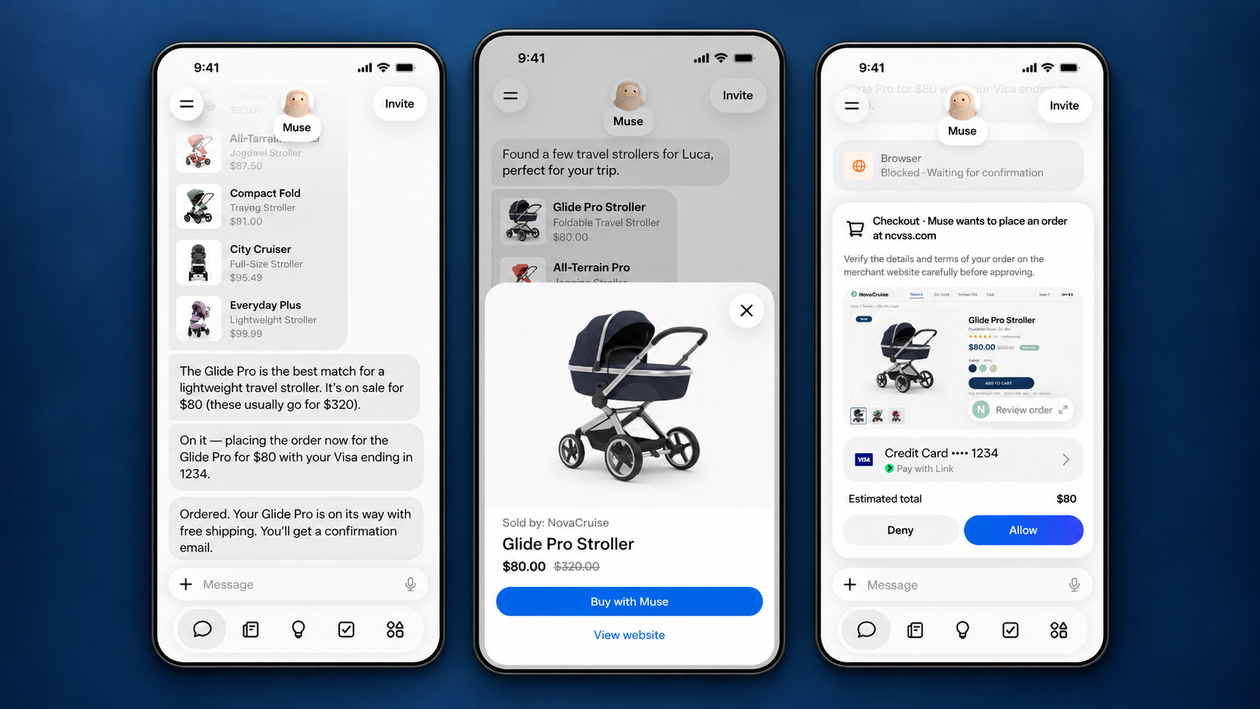
Simon sees the first generation of consumer agents moving beyond answers into real-world tasks. Adoption is one story; access, security and who controls the customer are the harder ones.
Muse is popular; Amazon draws a line
Business Insider reports Muse hit No. 1 among free US iPhone apps. The WSJ report (also published by Mint) describes the backlash and an 11% Meta share-price jump. Amazon blocked Muse shopping, saying it was unauthorised and did not identify itself; Meta says credentials are stored so the agent cannot see them.
Take: The fight is less “can the agent click?” than “who owns the checkout, ads and customer relationship?” Both companies have something to lose.
Sources: Business Insider ↗WSJ original ↗GeekWire ↗WSJ via Mint ↗
Source note: WSJ original did not load; its syndicated text was read at Mint. The 11% move is reported there, not independently calculated.
Meta extends Muse to Mac and a Charm
TechCrunch says Muse on Mac can work in native files, messages, calendar, notes and mail, with opt-in access and approval for sensitive actions according to Meta. A short Meta video demonstrates a small voice device dubbed Charm; the clip offers no meaningful product specifications.
Take: Putting the agent on your desktop raises the utility, and the permission stakes. A keyring demo is not yet a product proposition.
Sources: Charm video ↗TechCrunch ↗
Source note: Charm is only a demo in the linked short; no release date or capabilities beyond the clip were verified.
Thirty apps and Instinct
Jake Castillo’s LinkedIn list runs from private social loops to shopping and wellbeing apps; the lesson is to study the habit and distribution mechanism, not copy the visible feature. Simon also links Instinct and a long YouTube walkthrough: its reviewer praises simple onboarding, memory and execution but raises privacy concerns and some failed tasks. The video repeats an unverified $10bn fundraising rumour.
Take: The review is unusually useful because it shows both things working and friction. Treat the valuation line as rumour, not a benchmark.
Sources: Thirty-app list ↗Instinct site ↗Video walkthrough ↗
Source note: Valuation is the video’s rumour, not a confirmed financing. No invitation or call-to-action in the video is an instruction from Heni.
Azeem Azhar on the AI bubble
In a full conversation with The Atlantic’s Nicholas Thompson, Azhar argues that real demand and rapid technical progress do not guarantee that every valuation or investment pays back. They work through infrastructure spending, model economics, China and where value might settle.
Take: The sensible split is between “AI matters” and “every AI asset is priced correctly”. The interview offers a case against a simple bubble verdict, not proof that the capex pays off.
Sources: Full video and transcript ↗
OpenAI builds the ad stack
OpenAI is testing clearly labelled Sponsored Agents after an ad click with selected US advertisers. It also describes prompt-led campaign creation, AI copy/image suggestions, optional text customisation, and HubSpot and Shopify integrations.
Take: The ad product is moving from placement to a conversation that can qualify intent. That changes the creative, measurement and hand-off questions for brands.
Sources: OpenAI announcement ↗
Source note: These are OpenAI’s announced tests and integrations, not independently measured performance.
GAFA
Simon spotlights a court order aimed at Google’s ad-tech plumbing rather than a break-up.
Google keeps AdX, but must open the pipes
Judge Brinkema did not order an AdX divestiture. AdExchanger details interoperability with Prebid, AdX bids into rival publisher servers on comparable terms, bid data shared with publishers, and limits on AdWords favouring Google’s stack. A court-appointed technical monitor oversees the global remedies.
Take: Behavioural remedies depend on implementation and enforcement. For publishers this is potentially meaningful access, not an instant restoration of competition.
Sources: AdExchanger analysis ↗
Merchant
Simon links three versions of the same shift: shopping begins before search, and platforms want to own the moment of intent.
Instacart turns a prompt into a basket
Clementine uses recipes, lists, past orders, preferences and local inventory to build a cart in the US and Canada. Instacart says its underlying data spans 1.6bn orders, a 2bn-item catalogue and more than 10m daily inventory signals. Roger Dunn’s LinkedIn post summarises the features.
Take: The hard bit is not chat; it is a useful basket that is actually in stock at a real shop. The figures come from Instacart’s own release.
Sources: Roger Dunn ↗Instacart release ↗
TikTok creates demand that Amazon may close
FordeBaker argues that creator-led TikTok discovery can lift branded Amazon search and sales, so judging TikTok Shop only on its own last-click return understates its value. Its case study claims one tanning-mist brand’s Amazon revenue rose 456% in a month and cites blended ROAS research.
Take: Good hypothesis, weak causal proof from one agency case study. Test incrementality and margin across channels before crediting TikTok for all the Amazon lift.
Sources: FordeBaker essay ↗
Source note: The uplift and ROAS are agency/vendor claims; they are not independent incrementality estimates.
McDonald’s: delivery claim versus media network
A LinkedIn post repeats a $20bn delivery-sales claim and implies McDonald’s keeps all commissions. That latter claim is not established by the linked post. Marketing Dive confirms a separate development: a pilot media network at 450 US company-owned restaurants, with ads planned in apps, kiosks, boards and shops.
Take: Owned customer touchpoints are valuable; do not turn a social post into a verified margin claim. The media-network target is an ambition, not booked revenue.
Sources: LinkedIn delivery post ↗Marketing Dive ↗
Source note: Delivery figure and no-commission inference appear in a LinkedIn post and were not independently verified.
newtv
Simon moves from creator tools to the cost of rights, shrinking public-service budgets and a larger Hollywood merger.
YouTube wants its creators to stay
Neal Mohan outlines prompt-built home feeds, product discovery, AI editing, Shorts seasons and likeness detection. The WSJ reports YouTube is competing with Netflix for creator talent: its revenue-share model and brand deals must compete with Netflix’s upfront cheques.
Take: The battle is for the creator’s whole business, not just a video upload. YouTube can offer distribution and monetisation, but Netflix can write a guaranteed cheque.
Sources: Mohan’s announcement ↗WSJ report ↗
Source note: Full WSJ text did not load; the excerpt in Simon’s email and a secondary report supported this summary.
India’s micro-drama production line
The FT gift article describes 1–3 minute episodes, often in serials of 50 or more, shot cheaply and sometimes with AI help. It has created work for actors and crews as India’s conventional screen industry struggles.
Take: A phone-native format with brutal cliffhanger economics, not simply cut-down television. Low production cost is a distribution advantage and a labour question.
Sources: FT gift article ↗
UK public-service TV is squeezed
The Guardian reports Channel 4 plans to cut 28% of staff, BBC is looking at up to 2,000 cuts, and ITV questions whether a national streaming champion can match US platforms. The article sets these against falling linear ad revenue and licence-fee pressure.
Take: British broadcasters still commission culturally distinctive work; the funding model is the exposed flank. A merger alone does not fix the shift in attention.
Sources: Guardian ↗
The price of being a sports fan
Bloomberg’s interactive adds up the cheapest subscription combinations for in-market Los Angeles teams, assuming a viewer starts with no subscriptions and cancels when possible. Its Lakers example is $376 over four services; USC football tops the cost-per-game table at $8.15.
Take: Rights fragmentation is a consumer tax and a distribution puzzle. These are US/LA-specific modelled figures, not a UK sports budget.
Sources: Bloomberg interactive ↗
Paramount–Warner Bros deal moves closer
The FT gift article says Paramount settled with 12 US states over its $110bn Warner Bros Discovery deal. No major divestitures, but commitments include California operations, production spend, a CNN/CBS editorial board and theatrical-release minimums with penalties.
Take: A legal hurdle is gone, not the integration risk. The remedies tie merger approval to real output and editorial safeguards; watch delivery, not the headline price.
Sources: FT gift article ↗
pervert glasse
Simon’s playful heading for glasses. The contrast is between Meta building hands-on retail distribution and Snap showing a true AR interface.
Meta Lab expands the try-on network
Modern Retail reports six new standalone Meta Lab shops on top of eight existing locations, plus a plan for 50 Best Buy shop-in-shops by end-2026. Glasses still need fitting and a real-world demonstration, while privacy concerns remain.
Take: This is distribution infrastructure for an unfamiliar category. Do not confuse shop openings with mass adoption.
Sources: Modern Retail ↗
Snap Specs: promising AR, visible compromises
T3’s hands-on finds standalone full-colour AR, hand controls and usable demos, but bulky frames, a limited 51-degree field of view and the usual battery and comfort trade-offs.
Take: A credible glimpse of a different interface; still a demo, not evidence everyone wants a computer on their face.
Sources: T3 hands-on ↗
Plus+
The final note is a reported NBA Europe bidding story, but the Lite issue links only to the NBA Europe LinkedIn page, not to the report behind the bidder claims.
NBA Europe looks to football brands
Simon says a Tottenham Lewis-family consortium has bid for London and PSG, Bayern and Barcelona are discussing terms. The linked page is the NBA Europe company profile and does not itself substantiate those details.
Take: A plausible distribution strategy, but do not repeat the bidder names as confirmed awards. This is precisely where Lite’s missing source link matters.
Sources: NBA Europe profile ↗
Source note: Bidder claims come from the newsletter only; the underlying reporting was not linked or verified.